Author: Zhiyu (Jessica) Guo
March 2026
In 1996, Curtis Flowers, a Black man in Winona, Mississippi, was accused of a quadruple murder and tried six times over two decades while sitting on death row. The same District Attorney, Doug Evans, struck 41 of 42 Black prospective jurors he had the opportunity to remove, using peremptory strikes, which allow attorneys to dismiss potential jurors without stating a reason. The case reached the Supreme Court, which ruled 7-2 in Flowers v. Mississippi (2019) that Evans had violated Batson v. Kentucky (1986), the landmark ruling prohibiting race-based jury strikes.
The American Public Media (APM) Reports investigation that brought Flowers' case to national attention also sent reporters to Mississippi's Fifth Circuit Court District to collect data on all criminal trials from 1992 to 2017, yielding an 89-trial, ~15,000 juror dataset. This data opens a window into the landscape of prosecutorial peremptory strikes — and Flowers' case, it turns out, was not an anomaly.
In our research using this data, we estimated the average difference in strike rates between Black and white jurors of comparable characteristics using doubly robust estimation. This is a flexible nonparametric method where we adjusted for 120 covariates including gender, education, marital status, voir dire answers, judge, county, prosecutor, defendant race, and crime type. Even after accounting for all of these, the estimated difference in strike rates between Black and white jurors is 37 percentage points (95% CI: 0.31, 0.42, see Figure 1). Among the 2,282 jurors (due to availability of voir dire files) in our analytic sample, Black potential jurors face nearly 7x the odds of being struck compared to similarly situated white jurors.
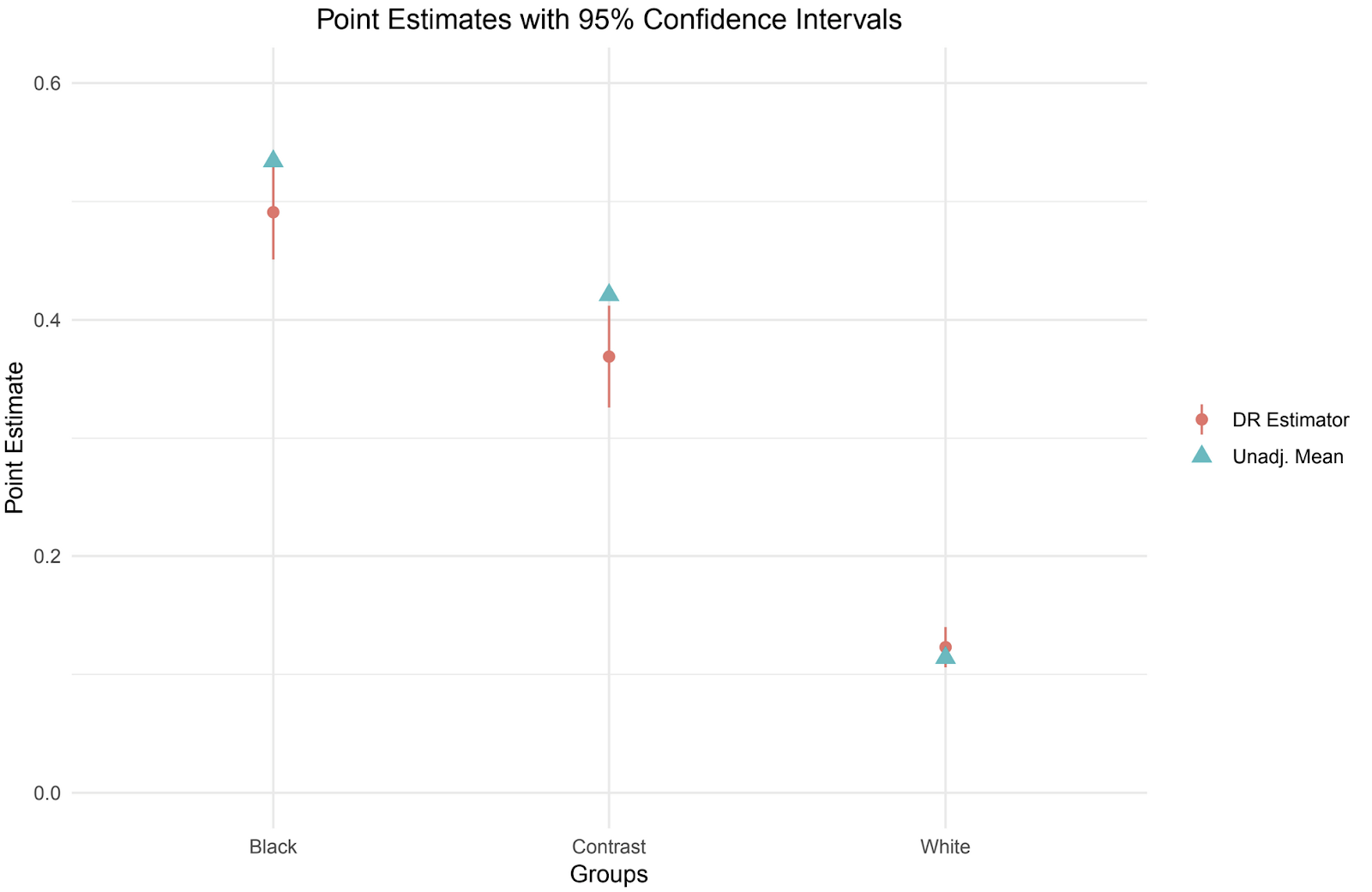
Figure 1: The average strike rates adjusting for covariates for Black, white, and their difference using doubly robust nonparametric ACD estimates, accompanied by the unadjusted mean strike rates and their difference as point estimates.
Beyond the average, we ask: where is the disparity largest? Knowing the defendant and having a family member or friend accused of a crime are the two covariates most strongly associated with greater racial disparity. These are precisely the jurors for whom prosecutors have the most readily available race-neutral justification for striking — yet the disparity is sharpest exactly among this group, suggesting that prosecutors are more likely to act on these justifications when the juror is Black than when the juror is white.
In 2022, Arizona became the first U.S. state to abolish peremptory strikes entirely. Washington (2018) and California (2020) replaced Batson's purposeful discrimination standard with an objective observer test, asking whether a reasonable person, aware of implicit bias, could view race as a factor. Under this standard, a pattern of disparities across hundreds of trials becomes legally relevant evidence, rather than requiring proof of intentional discrimination in any single case.
A third avenue for reform targets the information-gathering process itself. In the Flowers trials, Evans asked Black prospective jurors an average of 29 questions versus 1 question for seated white jurors. Washington's GR 37 and California's AB 3070 already require courts to consider whether an attorney asked "significantly more questions or different questions" of struck jurors compared to seated ones, a procedural check on the asymmetric interrogation that precedes discriminatory strikes.
For statisticians, the framework we develop is portable: with sufficient data, similar analyses could audit strike patterns in other jurisdictions, providing evidence that case-by-case Batson challenges cannot. Jury selection is one instance of a broader class of problems where a facially neutral process may conceal disparate racial impact, and the methods we apply here are well-suited to similar questions in bail, sentencing, and policing. We hope this work encourages statisticians to bring these tools to bear where the stakes for equal justice are highest. For more information, you can read the full paper on arXiv soon- we will post the link here when it is available.
1 https://features.apmreports.org/in-the-dark/mississippi-da-doug-evans-striking-black-people-from-juries/ , https://www.apmreports.org/in-the-dark/season-two
2 Flowers v. Mississippi, 588 U.S. 284 (2019); Batson v. Kentucky, 476 U.S. 79 (1986).
3 APM Reports. (2018). Peremptory strikes data, Mississippi Fifth Circuit Court District. GitHub. https://github.com/APM-Reports/jury-data
4 Washington Supreme Court General Rule 37 (2018); California AB 3070 (2020), Cal. Civ. Proc. Code § 231.7.
5 Craft, W. (2019, March 18). For Curtis Flowers, a question of race. APM Reports. https://www.apmreports.org/story/2019/03/18/curtis-flowers-black-prospective-jurors-questions